Monday, February 23, 2026
A Fever Dream in A Scanner Darkly
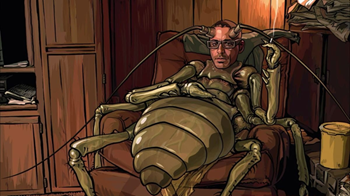
Last night, recovering from quite a debilitating cold I had a dream where there was an online stalker and impersonator of myself, who had used my identity to act as me and speak to my friends, all without myself knowing. When I figured out that it was happening, I drafted a long message about this unknown impersonator, ready to send to my friends as caution. Eventually, however, it was revealed that the online impersonator of myself was actually me.
My first thoughts about the dream upon waking up immediately went to Philip K. Dick’s A Scanner Darkly. In Dick’s novel, the protagonist—an uncover cover narcotics agent—was given a paradoxical assignment to spy on himself—which he couldn’t have refused in order to maintain his anonymity as an agent. He was to follow with the assignment through surveilling technologies, given and installed inside the protagonist’s home by the law enforcement agency. His work as a narcotics agent was hence to surveil over and examine the footage of himself in order to look for any evidence that the agency can use for an arrest. The protagonist who partly plays a role as a drug dealer in his investigation of the origins of the drug, Substance D, conversely also has to use the drug in order to work both in undercover, and in his investigation on himself as the unknown high-profile dealer due to his dependency on it. What then occurs in the novel is thus a series of events that causes the protagonist to lose the realization that he is playing both characters of the script: exacerbated by drug use he begins to form the belief that the person he is surveilling on is not really himself.
While in Dick’s novel there is Substance D, D standing for Death, or Slow Death, we have Discord instead. Where Substance D corrodes the tissue connecting the different hemispheres of the brain, causing its users to increasingly dissociate from themselves, platforms for online social interactions similarly encourage the expansion of a digital unconscious.
Substance D in the novel also results in the inability for its users to act. Internet discourse in the same vein becomes quickly paralyzing for any action to take place, due to how suffocatingly everyone has to regurgitate the most recent bad news all the time, just to have them be quickly forgotten and never discussed again, likewise repeated at a 12-hour interval. The terrible news of course continually get worse and worse because there is no mobilizing movement done to fix any of the issues that caused them in the first place; microdosed on death, an algorithm that purposefully produces negative reactions continue to stop any potentially meaningful mass action from being created.
From another point of view, the unpleasant symptoms that arise from being sick due to a common cold or flu is actually cyberpositive. The body’s immune system’s response to an external virus is to cause aches, fatigue, and high fever, even if it results in it fighting its own organs and host. Furthermore, the connection, circuitry between the identities of A Scanner Darkly’s protagonist similarly undergoes a cyberpositive runaway effect—obfuscating the two, and what is inside with the outside.