Saturday, March 07, 2026
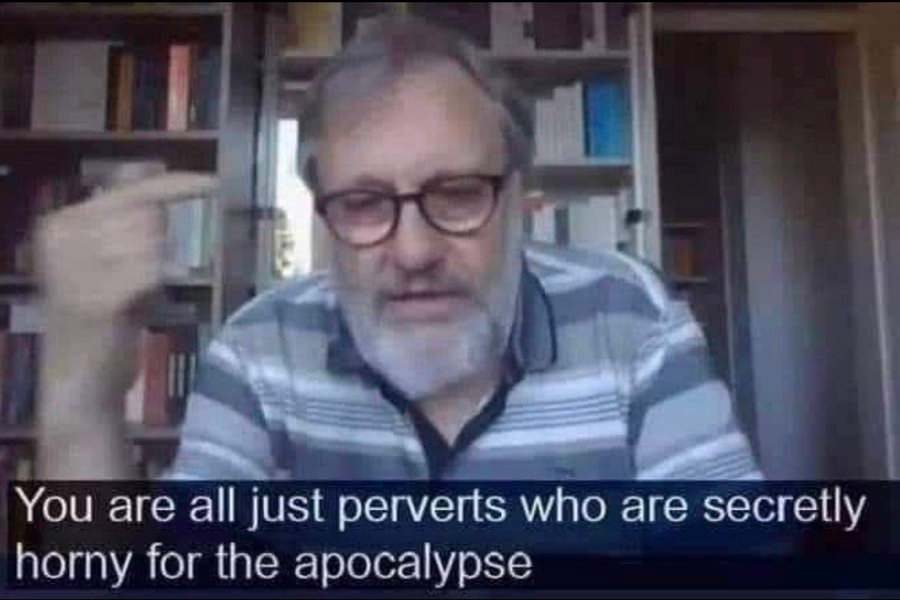
Perverts of the Apocalypse
It should be clear that the idea of an impending doom is pointless to dwell on for any pragmatic purposes. Doomerism is the same logic as, say, certain determinists in claiming that there will be a historical necessity for a violent class uprising to occur. Such a claim actually relish in violence, while distancing itself from the use of violence.
 The same is also true of suicide in the depressive: “the thought of committing suicide makes me happy enough, so that I never have to take it upon myself to end my own life…” (Remember Nietzsche’s dictum that the thought of suicide is a powerful solace…)
And so doomerism, more often than not, is just a tacit resignation. This resignation avoids having to deal with a common, collective feeling of anger, and instead channels it inward, which is why it so commonly culminates in depression.
Because the logic of resignation actively gives up on trying to account for how things are, it hence turns to transcendental explanations that amounts to nothing more than another, secular, form of Day of Judgement. It turns to feeble ideas, such that there will be a catastrophe to end all catastrophes, that the out-of-joint world can be put in order, coming together with the doomsday as its goal, in a point in history which concludes all history. While in the aforementioned case of left determinism, the agent of judgement is people instead of God, in the doomer’s case it is nature, AI, nuclear war, so on and so forth. If anything, it would be closer to the truth to say that the coming catastrophe—if there is one we are not already in—will not end all life on earth, but instead will preserve the lives of the most depraved, vile, and monstrous.
The common doomer perspective, thus is inversely actually a utopian view. The idea that everything will end in one dramatic finale is only a type of wishful thinking. The doomer can only hope that everything will end, when history cannot but be indifferent to mere human tragedies. It moves on regardless of any concern. Time can’t be bothered to put pause on itself.
In a different, but nevertheless utopian vein, we also say this to the apocalypsemonger that insists on preparing in anticipation for the future apocalypse. They too are utopian, for after all, doomsday preppers believe they can somehow emerge unharmed from whatever future apocalypse there will be—such belief of course is also sustained by the logic of resignation, only in a different light.
To conclude, it should also be clear that an event on the scale of a global apocalypse will evade all intelligible meaning, and to pin meaning onto it, is in the same stroke to resign facing the full weight of failures in everything past—they are catastrophes which can never be undone, and which further propel the angel of history into the future. Much like theodicy, whose principal task it is to explain why paradise is not a logical possibility (The Doors of the Sea, 58) by depriving evil of its irrationality, those who deal in inevitabilities and doomsdays similarly defer having to engage with politics. Here, it is the lesson of Job that should be applied: “The greatness of Job is not so much to protest his innocence as to insist on the meaninglessness of his calamities. When God finally appears, he affirms Job’s position against the theological defenders of the faith.” (Violence, 179)